Contact Us
 Donate
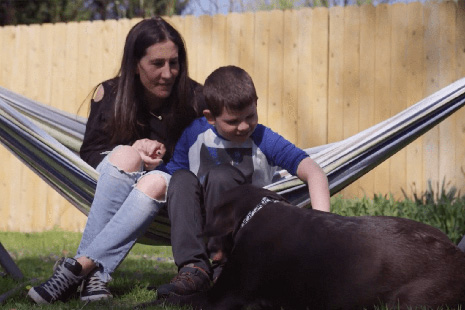
Welcoming a service dog into your family can be exciting and challenging. Service dogs offer new levels of independence for children with disabilities, but they can also add some unique challenges both inside and outside of the home.
We’ve outlined practical guidance for how to best utilize your service dog’s capabilities to support your child’s unique needs and create balanced family rhythms.
Fostering Independence & Autonomy
A service dog can be a powerful partner in helping your child build confidence and
independence. With thoughtful guidance, you can encourage your child’s autonomy while
ensuring their safety and support. Consider these simple ways your child’s service dog can
support their independence:
- Allow your child to give the dog commands and handle age-appropriate care tasks, like feeding or brushing.
- As your child’s confidence builds, move from leading to observing—let your child handle
commands, answer questions, and navigate public spaces while you stay close as backup
support. - Acknowledge and celebrate moments when your child demonstrates greater responsibility and advocates for themselves.
When children take ownership of their partnership with their service dog, they gain skills that extend far beyond the leash.
Protecting Childhood in a Medicalized World
Children with disabilities often spend a lot of time in structured, adult-led settings like therapy appointments. While these experiences are important, it’s equally crucial to preserve play. A service dog can be a bridge between structure and fun, supporting your child’s learning while still making sure they feel like kids.
Here are some strategies for integrating your service dog into both learning and fun:
- Incorporate your service dog in your occupational or physical therapy sessions: Walking the dog or playing fetch can teach motor skills in a fun, engaging way.
- Include the dog in daily routines: Simple tasks like setting the table or tidying toys can become opportunities for independence with the service dog as a partner.
- Encourage imaginative play: Let the dog join in pretend games, storytelling, or outdoor adventures.
- Allow unstructured time: Free play with your pup lets your child relax, explore, and enjoy simply being a kid without pressure.
By incorporating your service dog in your child’s learning and play, the dog becomes not just a helper, but a partner in childhood—supporting growth while making everyday moments fun and meaningful.
Strengthening Sibling Connections
Service dogs do more than support their handler—they can be a valuable teaching tool for the whole family. When introduced thoughtfully, services dogs can help siblings recognize and respect individual differences in abilities and needs and help them build other practical life skills that last into adulthood.
Here are some ways your service dog can teach empathy, cooperation, and connection between your children:
- Foster sibling empathy by explaining how the service dog helps their brother or sister and inviting questions about the dog’s role. Emphasize that the dog supports their sibling with disabilities rather than ‘fixing’ them, to help your child(ren) understand why the dog is important.
- Explain that fairness among siblings means each child gets what they need, even if it’s not the same for everyone. Using phrases like, “Your sibling needs help with X. You need help with Y,” and “Different bodies/brains work differently,” can help alleviate jealousy and inspire understanding.
- Involve siblings in simple care tasks to encourage teamwork and responsibility. Activities like grooming, walking, or playing with the service dog give siblings opportunities to work together and solve problems as a team.
Service dogs can play a role in fostering family bonds that last well beyond childhood.
Navigating Public Access
Navigating public spaces with a service dog can be a challenge. Understanding the rules and having strategies in place can help you advocate confidently while keeping your child’s experience positive.
Know Your Legal Rights
Parents should familiarize themselves with federal and state laws, such as the Americans with Disabilities Act (ADA), which protects the rights of individuals with disabilities to be accompanied by a service dog in most public places.
Service Dogs in Classrooms
Generally, service dogs are allowed in classrooms as long as they are well-behaved, properly trained, and their presence does not disrupt learning. Parents can work with teachers and administrators to establish a plan that includes the dog’s role, appropriate behavior expectations, and any necessary accommodations.
Handling “No Pets Allowed” Situations
Service dogs are not considered pets and cannot be denied access because of a “no pets” policy. If confronted, you can explain that your dog is a trained service animal assisting your child. It can also be useful to carry documentation or a brief ADA reference sheet for quick explanation, though legally, proof of certification is not required.
How UDS Can Help
Introducing a service dog into your family is a big life change, and we understand that it can come with both exciting opportunities and new challenges.
UDS is here to support your family every step of the way. Our specially-trained facility dogs for schools assist children who need assistance in the classroom, while our service dogs for those with mobility disabilities and autism assist with activities of daily living.
To learn more about our options for families considering a service dog and our service dog program, please contact us to get started.