Contact Us
 Donate

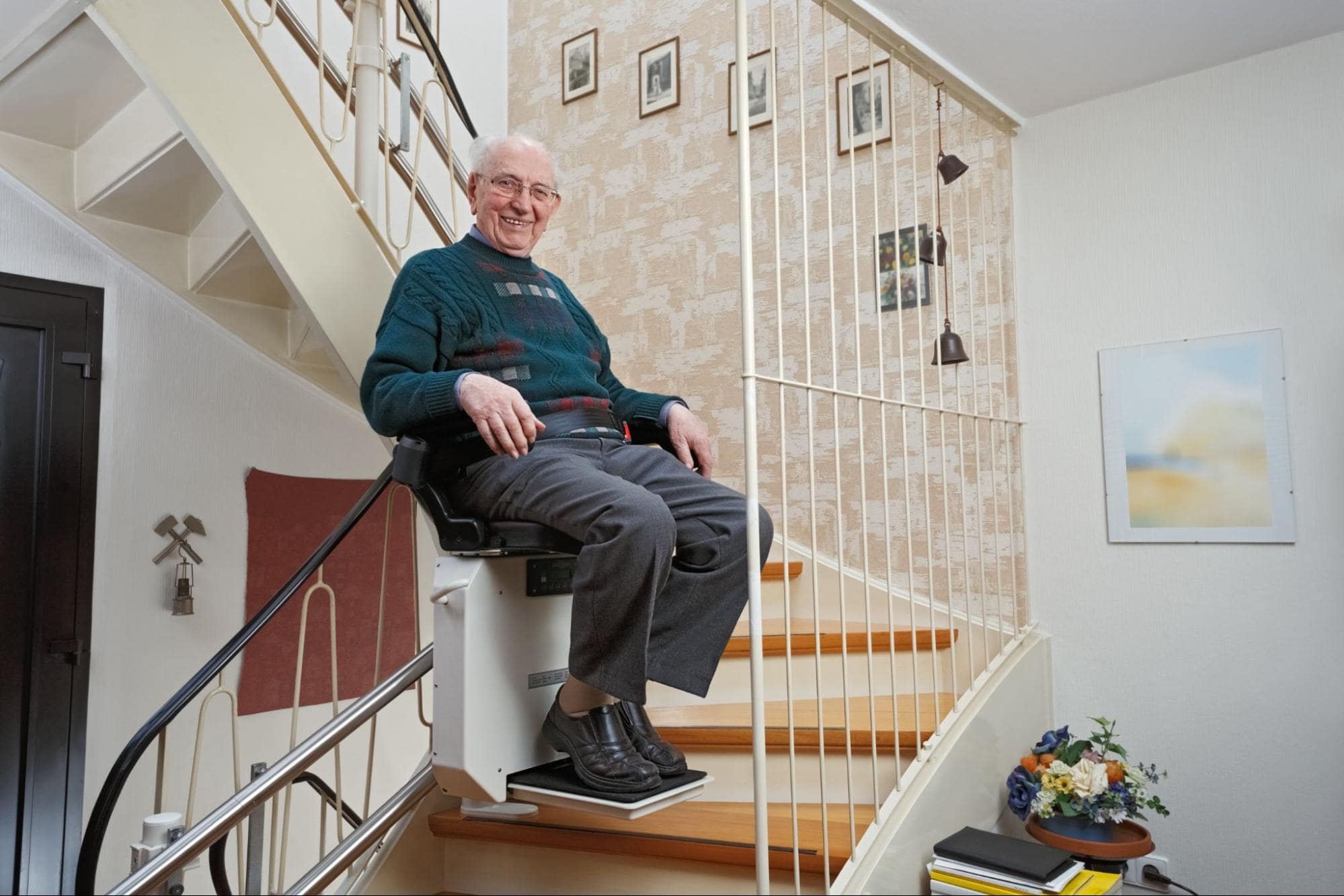
A stairlift is the right solution for many people. It gives back the half of a house that had quietly become off limits, it costs a fraction of moving, and it removes the single most dangerous trip a person makes in their own home each day.
It is also the wrong solution for some people, and the companies whose only business is selling lifts are not always the ones who will say so. The questions below are the same ones we work through during an in-home evaluation. Most of them you can answer yourself right now, before you spend a dollar or talk to anyone.
1. Can the Rider Sit Safely Without Support?
Start with the most basic question, because everything else depends on it. Can the person who will ride the lift sit unassisted in an ordinary kitchen chair, with no risk of sliding forward or leaning off to one side?
Some conditions reduce core strength or trunk control to the point where staying upright in a moving seat is not safe. If the honest answer is no, or even that you are not certain, a stairlift is not the right purchase and a different solution should be explored instead. This is the one question where being too hopeful in your answer, and not grounded in strict reality, can lead to a genuinely dangerous outcome.
2. Will the Rider Actually Be Comfortable Using It?
Riding a chair up a staircase is a new experience, and not everyone takes to it. For someone living with a cognitive condition, a moving seat can be frightening or confusing, and a rider who tries to stand up partway through a ride is in real danger.
Think this through honestly before the money is spent. It is not unusual for a family to install a lift that the intended rider then refuses to use. If there is real doubt, that is worth raising during an evaluation so it can be discussed openly rather than discovered afterward.
3. Is the Lift Rated for Enough Weight?
Undersized motors are one of the most common causes of stairlift breakdowns. A lift that is technically rated above the rider’s current weight, with no margin left over, is a lift that will be working at its limit every single trip.
As a general rule we recommend choosing a lift rated for roughly 120 percent of the rider’s weight. That leaves room for change over time and protects the motor and gearbox. Buying the cheaper, lower capacity unit tends to cost more in the end, in service calls and in shortened equipment life.
4. Are Your Stairs Wide Enough for the Rider, Not Just the Lift?
Most manufacturers list a minimum stair width of around 32 inches. That number describes the lift. It does not describe the rider, and the rider is what usually determines whether a staircase works.
Here is how to check it yourself. Have the rider sit in a kitchen chair. Measure from the back of the chair to the front of their knees, then add about seven inches to account for the rail. That total is the minimum stair width you need. Measure your staircase at its narrowest point, not at the widest or in the middle, because the narrowest point is where a knee would strike a wall or a banister.
If your measurement comes out close to the limit, do not rule the project out on your own. Have the number handy during an evaluation and have it confirmed in person.
5. Does a Curved Staircase Really Require a Curved Lift?
Not always, and this is one of the most expensive assumptions a family can make. Curved lifts are custom manufactured for one specific staircase, which is why they cost considerably more and take longer to arrive than straight lifts.
If your staircase is divided by a landing and the rider can safely manage the few steps across it, two straight lifts installed on either side often do the same job for far less money. Similarly, if the bottom flight is only two or three steps, walking those steps may be perfectly reasonable and will save a significant amount. The deciding factor is always whether the transfer is genuinely safe for that particular rider, which is a judgment best made in the home.
6. Will Your Stairs and Wiring Pass Code?
Building codes and permit requirements vary by municipality, and they occasionally add cost that families did not budget for. Many jurisdictions now require enclosed railings rather than a single open banister, and a contractor may need to bring your steps into compliance before a lift can be installed.
Electrical is the other item worth checking early. The lift needs a properly grounded outlet within reasonable reach. Ungrounded outlets, or outlets so distant that an extension cord would be needed, can damage the unit and will typically void the manufacturer’s warranty. All of this is far cheaper to identify during an evaluation than to discover on installation day.
7. Would a Different Kind of Lift Serve You Better?
A stairlift carries a seated rider. It does not carry a wheelchair or a scooter. If the rider uses a mobility device and would need it on both floors, a stairlift solves half the problem and creates a new one, because the device has to be duplicated or somehow moved between levels.
In those situations a vertical platform lift or an inclined platform lift is often the better answer, since both carry the rider and the mobility device together. For outdoor steps, a porch, or a deck, a vertical platform lift is frequently the right solution where a ramp would simply be too long to fit the yard. It is worth asking about these alternatives even if a stairlift is what brought you to the conversation.
How UDS Can Help
UDS is a 501(c)(3) nonprofit that has served Pennsylvania for more than 60 years. Most stairlift companies are dealerships whose business is selling lifts. Home modification is one part of a much larger mission for us, which is why we are willing to tell a family that a stairlift is not the right answer for their situation.
Our in-home evaluation is free and carries no obligation. We work through every question above with the rider present, and we look at the whole home rather than just the staircase, including doorway widths, bathroom access, thresholds, and lighting, so that solving one problem does not create the next one. If the honest answer is a ramp, a set of grab bars, a bathroom modification, or moving a bedroom downstairs, we will tell you that.
For more information regarding whether a stairlift is right for your home, and how UDS can help you work through these questions, please fill out a request form and one of our specialists will be in contact with you within 24 hours, Monday through Friday, to help you get started.